Makefile: Streamlining CI/CD with Universal Build Commands
Makefile: Streamlining CI/CD with Universal Build Commands
Makefiles serve as both documentation and executable build instructions across development environments. By abstracting common commands like make test or make deploy, teams maintain consistent build processes from local development through production.
Do you want to learn AWS Advanced AI Engineering?
Production LLM architecture patterns using Rust, AWS, and Bedrock.
Check out our course!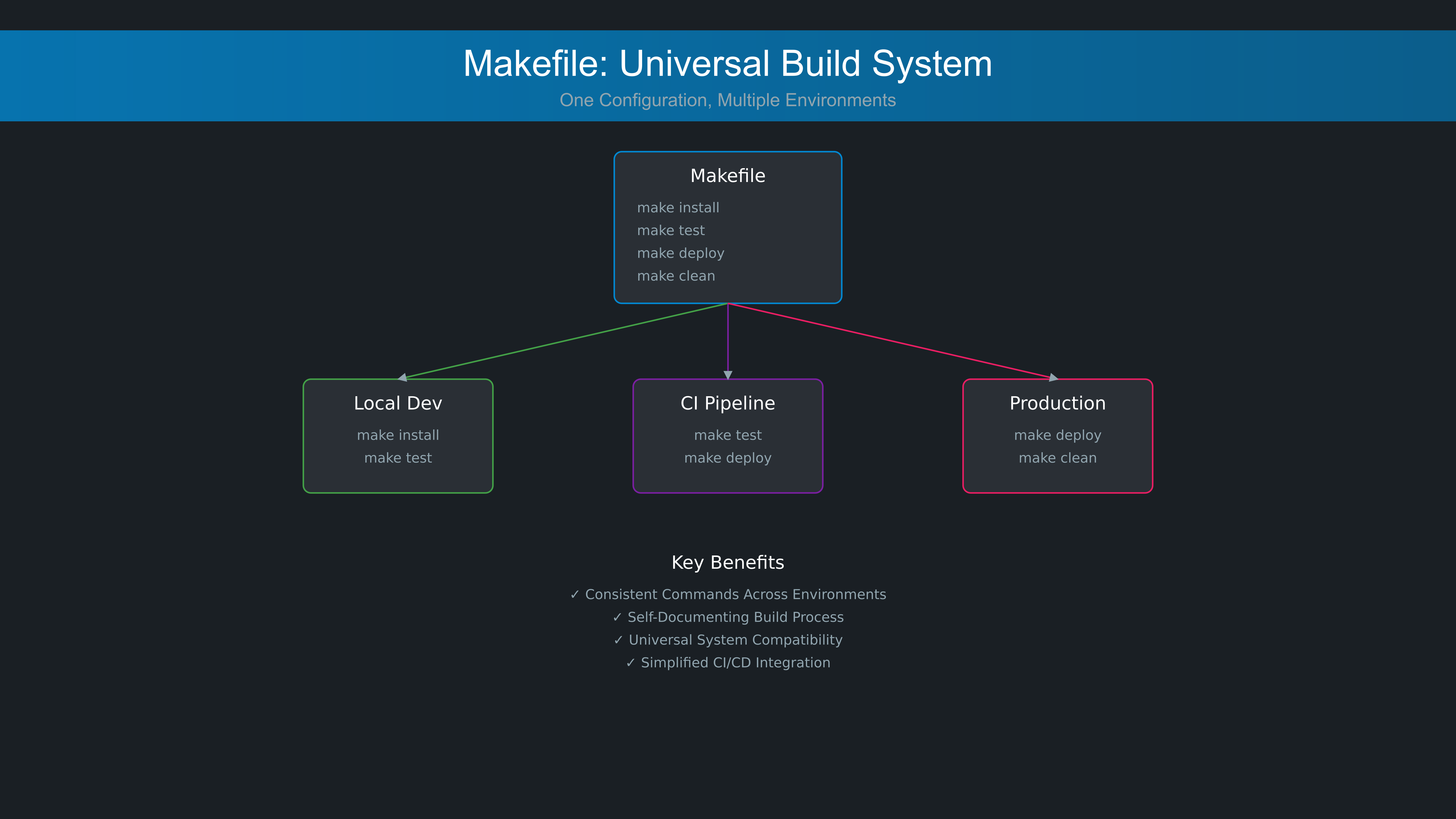
Universal Build System
Standardized Commands
A well-structured Makefile provides commands that work identically across environments:
.PHONY: all clean install test release
BINARY = mp4converter
INSTALL_DIR = $(HOME)/.local/bin
TARGET = target/release/$(BINARY)

all: check install

check:
    cargo fmt -- --check
    cargo clippy -- -D warnings
    cargo test

install: $(TARGET)
    cp $(TARGET) $(INSTALL_DIR)/$(BINARY)

$(TARGET):
    cargo build --release

clean:
    cargo clean
    rm -f $(INSTALL_DIR)/$(BINARY)

test:
    cargo test

release: check
    cargo build --release
Cross-Environment Compatibility
The same make commands work seamlessly in:
- Local development environments
- CI/CD pipelines
- Production systems
- Any environment with basic shell access
Key Benefits
- Self-Documenting: The Makefile itself serves as clear documentation of build steps
- Universal Compatibility: Make is available on virtually all Unix-like systems
- CI/CD Integration: Pipelines can use identical commands as developers, reducing configuration drift
One command - make install - can handle complex tasks like checking dependencies, building releases, and installing binaries. This consistency ensures reliable builds across all stages of development.
Best Practices
- Use
.PHONYdeclarations for targets that don't create files - Define clear variables for reusable values
- Include dependency relationships between targets
- Provide helpful error messages for missing dependencies
Recommended Courses
Based on this article's content, here are some courses that might interest you:
-
AWS Advanced AI Engineering (1 week)
Production LLM architecture patterns using Rust, AWS, and Bedrock. -
Enterprise AI Operations with AWS (2 weeks)
Master enterprise AI operations with AWS services -
Natural Language AI with Bedrock (1 week)
Get started with Natural Language Processing using Amazon Bedrock in this introductory course focused on building basic NLP applications. Learn the fundamentals of text processing pipelines and how to leverage Bedrock's core features while following AWS best practices. -
Natural Language Processing with Amazon Bedrock (2 weeks)
Build production NLP systems with Amazon Bedrock -
Generative AI with AWS (4 weeks)
This GenAI course will guide you through everything you need to know to use generative AI on AWSn introduction on using Generative AI with AWS
Learn more at Pragmatic AI Labs